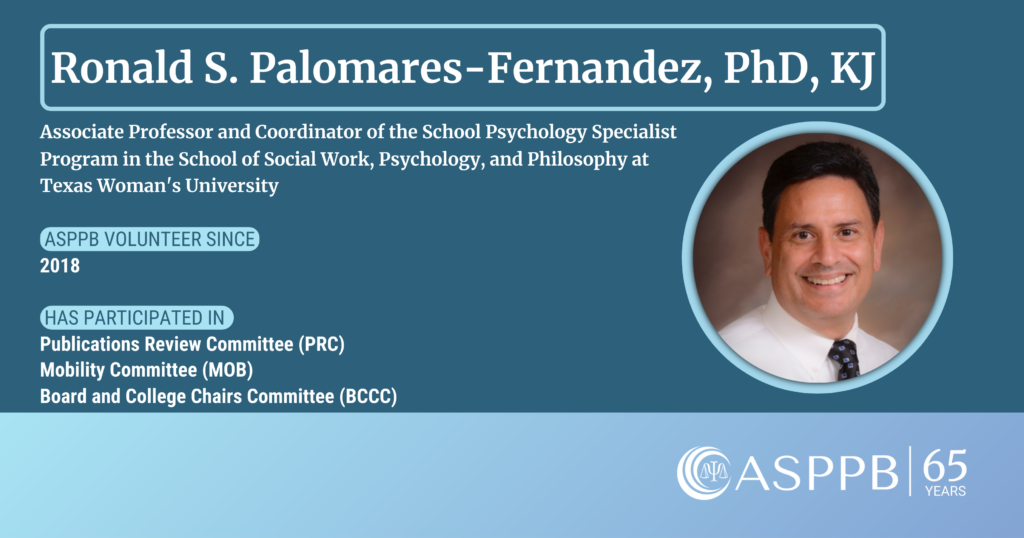
Prepared to Serve: Ronald S. Palomares-Fernandez on Volunteering with ASPPB

A psychologist’s perspective on public protection, purposeful engagement, and the benefit of staying ready
For Ronald S. Palomares-Fernandez, PhD, KJ, Associate Professor and Coordinator of the School Psychology Specialist Program in the School of Social Work, Psychology, and Philosophy at Texas Woman’s University, the path to volunteerism with the Association of State and Provincial Psychology Boards® (ASPPB) grew naturally from years of professional engagement at the intersection of psychology and regulation.
After spending 13 years at the American Psychological Association (APA)®, where he collaborated closely with ASPPB on developing telepsychology guidelines, his appointment to the Texas Psychology Board in 2017 marked a new chapter in his involvement with the regulatory community.
In 2018, he answered ASPPB’s call for volunteers and joined the Mobility Committee (MOB), which promotes responsible mobility for psychologists across ASPPB jurisdictions by administering credentialing programs and providing member jurisdictions with timely guidance on the professional and legal developments that shape how psychologists practice across borders.
His leadership within the association continued to grow. In 2022, Dr. Palomares-Fernandez became chair of the Mobility Committee after serving on ASPPB’s Publications Review Committee (PRC) from 2020 to 2021. Following a brief hiatus to fulfill a teaching assignment abroad, he rejoined the PRC in 2026.
Inside the Publications Review Committee (PRC)
The PRC reviews, maintains, and recommends to ASPPB’s Board of Directors the creation and revision of publications that serve licensing boards, psychologists, and the public, with the guidance documents the committee produces serving as professional resources. Dr. Palomares-Fernandez invokes the Boy Scout motto as the clearest analogy: be prepared. For him, that is the PRC’s defining orientation: proactive, purposeful, and grounded in the understanding that preparing guidance today serves the communities that will rely on it tomorrow.
This perspective reflects his commitment to service and his appreciation of the PRC’s contributions to keeping ASPPB’s publications current, accurate, and relevant for the audiences they serve. Currently, the PRC is revising the Guidelines for Closing a Psychology Practice, published in 2020 by ASPPB’s Professional Termination Taskforce (PTT) created in 2018. This document was prepared in response to discussions held within the ASPPB Board Administrators and Registrars Committee (BARC) regarding the desirability of consistency across jurisdictions in the guidance provided to practitioners on practice closure.
The culture found within the PRC has reinforced what Dr. Palomares-Fernandez has come to recognize as a hallmark of ASPPB’s volunteer community more broadly. The committee, comprised of five members, arrives prepared, follows through on commitments between meetings, and engages with the committee’s charge with a consistency that speaks to their alignment with the organization’s mission to support member jurisdictions in fulfilling their responsibility of public protection.
“Everyone is so knowledgeable, friendly, and supportive of the work of the committee and ASPPB,” he says. That reliability, he has found, creates a working environment where trust develops naturally, and the committee’s charge can move forward with purpose. He also notes the benefit of in-person connection within that dynamic. “While virtual meetings enable productivity across distances, the conversations that happen in the margins of an in-person gathering, during breaks, over meals, and between sessions,” he says, “build a depth of professional relationship that strengthens the committee’s collective progressive work, meaningfully contributing to cohesion within the group.”

“I remain impressed by the quality of the staff at ASPPB – professional, knowledgeable, helpful, and friendly.”
Ronald S. Palomares-Fernandez, PhD, KJ
The Benefit of Diverse Perspectives in ASPPB’s Volunteer Community
One experience from Dr. Palomares-Fernandez’s years of ASPPB volunteer service has stayed with him, though it did not occur in a committee meeting. It happened at a table during his first ASPPB annual meeting, in a conversation about the EPPP and its direction. Having recently joined the Texas Psychology Board, he arrived with a perspective shaped by his Texas and Southwest context, with the differing perspectives he encountered at that table expanding it significantly. Colleagues from across the United States and Canada offered views he had not considered, with concerns, consequences, and implications that his own regional experience had not prepared him to anticipate. “I had to start thinking from a broader perspective about the unintended consequences for individuals beyond my experiences and my state,” stated Dr. Palomares. He has carried that lesson forward ever since, approaching regulatory questions with greater curiosity, more careful listening, and a deeper appreciation for what perspectives beyond his own can offer.
“Diversity is not only a matter of background or ethnicity, but it also encompasses career stage, geographic region, and practice context. A wider range of volunteer perspectives produces a broader knowledge base, which ultimately makes the association more informed and more responsive to the communities it serves,” he emphasizes, thinking about where ASPPB’s volunteer community has the greatest opportunity to grow. He also points to the role ASPPB’s staff serves in supporting that breadth of engagement. Drawing on his experience as a former association staff member, he speaks to the behind-the-scenes preparation and dedication that makes volunteer participation possible. “I remain impressed by the quality of the staff at ASPPB — professional, knowledgeable, helpful, and friendly,” a standard that Dr. Palomares-Fernandez says has held without exception across almost a decade of engagement.
Every volunteer contribution, across committees, publications, and programs, reflects a shared commitment to the communities that psychology regulation exists to protect. For Dr. Palomares-Fernandez, years of engagement have led him to one clear conviction: “Volunteers are vital to the life of an organization.” ASPPB shares that belief and is grateful for every professional across its 66 member jurisdictions in the United States and Canada who chooses to bring their time, perspective, and dedication.
To learn more about those who graciously contribute to ASPPB as volunteers, visit: ASPPB Stories