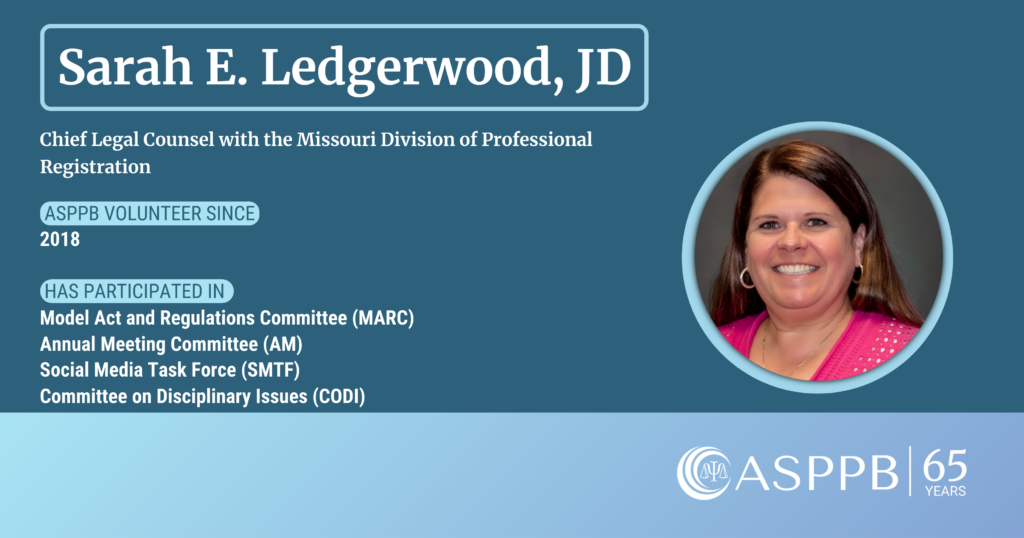
In Service of the Public: Sarah E. Ledgerwood on Volunteering with ASPPB

A chief legal counsel’s perspective on public protection, regulatory clarity, and community.
For Sarah E. Ledgerwood, JD, Chief Legal Counsel for the Missouri Division of Professional Registration, her path into the Association of State and Provincial Psychology Boards (ASPPB)® volunteerism grew with professional engagement. In the fall of 2015, her colleague and mentor, Pamela Groose, Executive Director of the Missouri State Committee of Psychologists, introduced her to the ASPPB community, and the experience left a lasting impression. Two years later, when an ASPPB survey offered the opportunity to formally contribute, Ledgerwood raised her hand in service.
In 2018, she joined the Committee on Disciplinary Issues (CODI), where she helped promote consistency in how discipline is resolved and reported across jurisdictions. She also contributed to the development of training materials and tools for jurisdictional board staff. That same year, she joined the Social Media Task Force (SMTF), which surveyed membership, reviewed relevant literature and ethical codes, and developed guidelines and regulatory language recommendations for jurisdictions on psychologists’ use of social media.
She has remained actively involved with ASPPB ever since. She joined the Annual Meeting Committee (AM) in 2025 and has served continuously on the Model Act and Regulations Committee (MARC) since 2019.
Inside the Model Act and Regulations Committee (MARC)
“I try to be multiple things: the voice of a lawyer, the voice of my state, and a little bit of the voice of the public,” Ledgerwood says of her approach to committee service.
As a lawyer, she brings precision and an understanding of how regulatory language functions in practice. As a representative of Missouri, she ensures that the perspective of a mid-sized jurisdiction is present in discussions that shape standards across ASPPB’s 66 member jurisdictions, and as a self-described voice for the public, she advocates for language that people can understand and follow.
That three-dimensional perspective finds its clearest expression on the Model Act and Regulations Committee, where her work sits at the intersection of legal expertise, jurisdictional representation, and public accessibility.
MARC is responsible for reviewing and updating ASPPB’s Model Act, Regulations, and Code of Conduct on an ongoing basis, ensuring that the foundational documents that guide psychology regulation across member jurisdictions remain current, consistent, and aligned with the field’s evolving needs.
Ledgerwood’s professional background shapes her approach to the committee’s work in practical ways. As someone who drafts legislation and regulations professionally, she has seen firsthand what happens when regulatory language becomes so complex that the people it governs struggle to understand what is required of them. She brings that awareness to every MARC discussion, advocating for language that is both precise and accessible without sacrificing the rigor that effective regulation demands.
“How can I expect you to follow my regulations as a psychologist if you don’t know what they mean?” she asks.
For Ledgerwood, effective regulation begins with clarity. She believes compliance starts with understanding, and commitment to clear, accessible language guides her contributions to the committee’s work.
“If you are prepared and are willing to participate, you can do it!” Ledgerwood says, a philosophy that extends well beyond the logistics of remote attendance.
At a recent MARC meeting, she participated virtually alongside colleagues who were present in person. What followed, thanks to all in the room, was one of the most productive hybrid meetings the committee had experienced. She attributes the result entirely to the preparation and engagement each participant brought to the table.
“If I don’t give something voice and I don’t speak up to share what’s on my mind, then I’m not protecting the public and I’m not protecting the integrity of this profession.”
– Sarah E. Ledgerwood, JD
The Community Behind the Mission
“I have found my people, and I have found my niche,” Ledgerwood says of her years with ASPPB, a sentiment she traces back to her very first meeting. The sense of welcome she encountered from the beginning has remained constant throughout her volunteer engagement, extending to colleagues, ASPPB’s broader membership, and staff.
Having spent years attending the Association’s members’ Annual and Midyear meetings, presenting topics relevant to her jurisdiction and legal expertise, she has found in ASPPB a professional community defined by mutual respect, shared purpose, and a genuine investment in the work of public protection. “It really is my favorite thing to do,” she states.
For Ledgerwood, the connection between daily work as Chief Legal Counsel and volunteer service with ASPPB is direct and deliberate. “If I don’t give something voice and I don’t speak up to share what’s on my mind, then I’m not protecting the public, and I’m not protecting the integrity of this profession.”
That sense of responsibility extends to her understanding of ASPPB’s overall structure. She describes the relationship between ASPPB’s committees and the organization’s mission to support member jurisdictions in fulfilling their responsibility for public protection through an analogy that speaks directly to her: a puzzle.
Each committee, each volunteer, and each perspective contribute a piece. “Without all of the pieces, none of us can really accomplish anything,” she says. It is a conviction she brings to every committee she serves on and one that has kept her engaged across each role.
To learn more about those who graciously contribute to ASPPB as volunteers, visit: ASPPB Stories