ASPPB’s EPPP Volunteers: Dr. Valentina Pacheco-Cornejo on Service and Representation

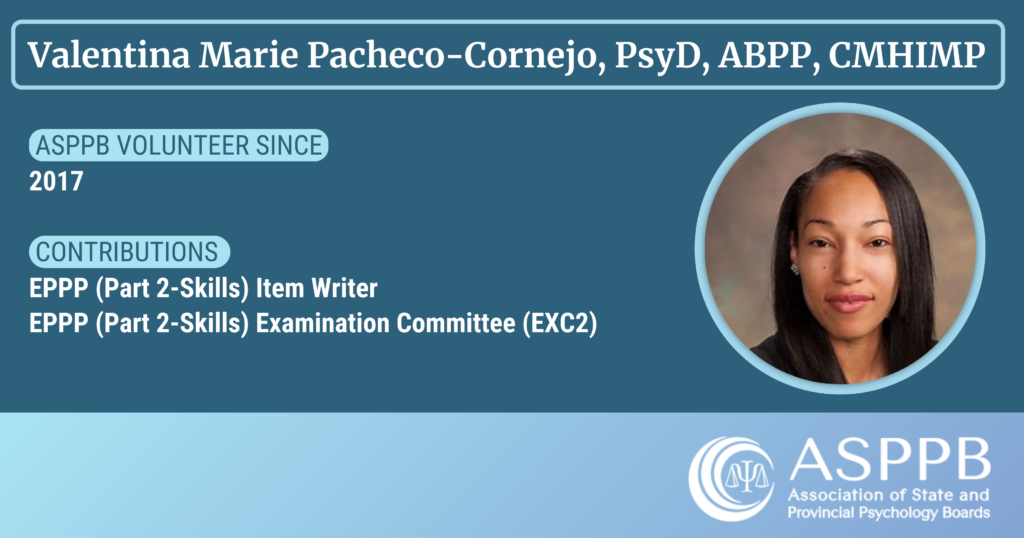
Valentina Marie Pacheco-Cornejo, PsyD, ABPP, CMHIMP, a volunteer with the Association of State and Provincial Psychology Boards® (ASPPB), demonstrates the profound impact one psychologist can have when professional expertise, personal experience, and a commitment to equity come together. Her journey as an ASPPB volunteer is especially meaningful because she brought perspectives shaped by her identity as a Puerto Rican and Black psychologist, her family’s Mexican heritage, and her experience as an early-career psychologist. Her service shows why representation matters to the Association: diverse professionals have a seat at the table, and their perspectives enrich the questions asked and the decisions made.
An Unexpected Opportunity Unfolds
Dr. Pacheco-Cornejo’s involvement with ASPPB began somewhat unexpectedly. While completing her postdoctoral fellowship and newly licensed, she encountered a call for licensed psychologists to participate in item writing for the Examination for Professional Practice in Psychology® EPPP (Part 2–Skills). Although the opportunity was not specifically directed to postdoctoral fellows, the fellowship’s training director circulated the announcement to the psychologists at her site; she saw it, recognized that she was eligible, and applied.
Her initial role was as an item writer, contributing to the relationship domain and participating in broader discussions across examination domains. Her willingness to ask questions and engage actively in those discussions eventually led to a larger role as an EPPP (Part 2– Skills) examination committee member, including responsibility for child and adolescent assessment and intervention items.
Her contribution matters because of her motivation. Dr. Pacheco-Cornejo wanted to help protect the field of psychology and safeguard the people it serves, but she was also concerned about the experiences of Black and Brown psychologists taking the examination.
“My work with ASPPB’s team is in part to enrich and revise items to adequately reflect diverse ways of understanding the world,” said Dr. Pacheco Cornejo. “Our concern is not about lowering standards. Rather, we examine whether the assessment was comprehensive, culturally relevant, and equitable.”
Her perspective also led to closer examination of how race and ethnicity were represented in test questions. She noticed that questions sometimes identified Black, Brown, or Asian individuals by specific ethnic or cultural labels while White individuals were more often simply described as “White.” These observations opened conversations among committee members about how language, culture, ethnicity, and identity should be represented in assessment. The committee did more than write questions; members reviewed and reworked items, offered feedback, and considered whether cultural or ethnic information was actually relevant to what a question was intended to measure.
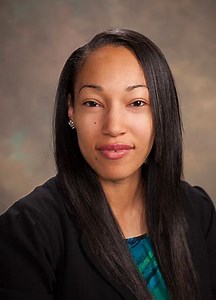
Dr. Pacheco-Cornejo’s Afro-Latina identity was therefore not incidental to her service. It shaped the lens through which she evaluated professional practices and brought experiences others in the room might not have considered. At the same time, she did not reduce her contribution to simply representing a demographic group. She emphasized that she was selected for what she brought to the work: knowledge, preparation, questions, energy, and a willingness to speak up.
“Part of group collaboration involves patience and the need to underscore concerns when needed,” said Dr. Pacheco-Cornejo. “Listening and being heard and supported by a brilliant group of colleagues is important. We all serve a greater purpose: to safeguard licensure and create the best possible items for the EPPP.”
Balancing Knowledge, Early-Career Work and Volunteering
An early-career licensed psychologist is within their first decade of practice. For many psychologists, this could mean establishing or solidifying a practice while potentially raising a family and balancing volunteer work. Having a full life did not deter her from her desire to serve. She encourages the importance of early-career psychologists participating in professional leadership and openly discussed the uncertainty and imposter syndrome that can accompany being one of the younger professionals in an established group. Yet she recognized that early-career psychologists have perspectives that can be lost if they remain silent. Her experience shows that professional service is not reserved for psychologists who have spent decades in the field. Emerging professionals can make meaningful contributions precisely because they bring fresh experiences and questions. This perspective matters, especially since the test is written with graduate students’ knowledge and skill base in mind.
“Feeling supported by established professionals such as Jacqueline B. Horn, PhD, helped me to offer my ideas without questioning what I had to offer.” Support from more experienced psychologists matters because supportive colleagues create a safe space for early-career professionals to contribute, bring their experiences to the table, and help the team create better items for the EPPP.
This support was particularly meaningful because Dr. Pacheco-Cornejo held responsibility for both the child and adolescent assessment and intervention domains, while other committee members shared comparable responsibilities for adult items.
Perhaps most importantly, Dr. Pacheco-Cornejo’s story demonstrates that volunteerism can require significant personal sacrifice and a sense of adventure. She gladly balanced ASPPB responsibilities with her practice, marriage, and young children. Her family was sometimes part of the journey, traveling with her to meetings at her expense, which allowed her to maintain a healthy work-life balance while serving as a volunteer.
Ultimately, Dr. Pacheco-Cornejo’s ASPPB service represents the power of showing up, speaking up, and sharing what one knows. Her story reminds the profession that diversity is not merely about who is present in a room; it is about whether people feel empowered to contribute their experiences and whether those experiences influence the work.
Advice to Early Careers Psychologists Considering Volunteering
“Preparation is important. Being at the right place at the right time and not shying away from service matters,” says Dr. Pacheco-Cornejo. “As an Afro-Latina, a Black psychologist, a mother, and an early-career professional, it is important to be willing to contribute as a volunteer, helping create space for greater cultural awareness, more thoughtful assessment, and a broader understanding of what it means to serve psychology’s future.”
Her legacy is therefore larger than a committee assignment. It is a model of professional citizenship: recognize an opportunity, prepare for it, seize it, and then use your voice to make the profession better for all.
Read more about ASPPB’s volunteers and learn about their contributions to support ASPPB’s mission to support member jurisdictions in fulfilling their responsibility of public protection.