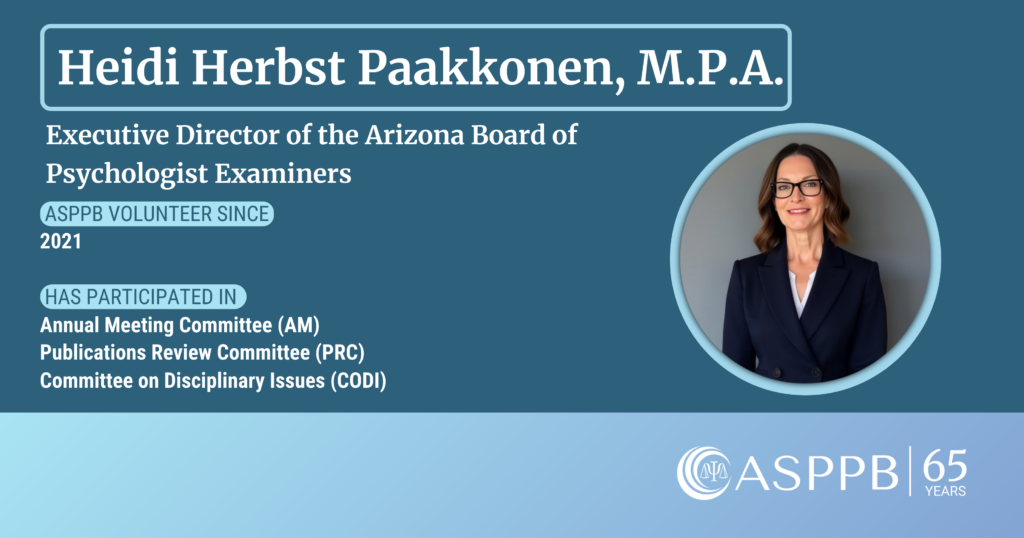
Regulation, Compassion, and Community: Heidi Herbst Paakkonen on Volunteering with ASPPB

A regulator’s perspective on public protection and professional growth.
Psychology regulation is not a solo endeavor. The professionals who ensure that licensed psychologists are competent to serve the public, including board and college administrators, utilize networks built through shared commitment. Heidi Herbst Paakkonen, M.P.A., Executive Director of the Arizona Board of Psychologist Examiners, has been one of those committed contributors since 2001. Before joining the psychology regulatory community, she spent years as a physical therapy regulator, where deep volunteer engagement was integral to conducting business.
Upon her transition to psychology regulation in November of 2019, engaging with the Association of State and Provincial Psychology Boards (ASPPB)® was not a question she needed to answer; in her words, it was a foregone conclusion. Since her first assignments to the Annual Meeting (AM) Committee and the Committee on Disciplinary Issues (CODI) in 2021, she has remained continuously engaged, currently contributing an administrator’s perspective to the Publications Review Committee (PRC) and the AM Committee while building professional relationships that have shaped how she leads at home in Arizona.
A Culture Built on Shared Perspective
Across committees, Heidi Herbst Paakkonen has found an environment that recognizes the administrators’ perspective as a valuable resource. That sense of community and belonging, grounded not in title but in the genuine appreciation placed on what each volunteer brings to the table, has kept her consistently engaged since her introduction to volunteering with ASPPB. “I’ve always felt welcomed and valued,” she states, “I’ve never felt that I need to apologize for saying, well, this is how I see it.”
Among the relationships that have shaped her most is one with Lori Rall, Executive Director of the Alabama Board of Examiners in Psychology and a fellow ASPPB volunteer. It was Rall who helped model for Paakkonen what compassionate regulation looks like in practice, passing the understanding that public protection and human dignity are not in tension. A disappointed applicant, a complainant who hoped for a different outcome, or a psychologist whose practice falls below the acceptable standard, each of those situations is connected to a person. “While we have a responsibility to protect the public,” Heidi says, “we can still do that with professionalism, grace, and a degree of compassion that the human beings we’re dealing with deserve.” She carries that philosophy into her work, recognizing that regulatory action framed as corrective rather than punitive signals something meaningful: there may still be a path forward or an opportunity to get a practitioner back on the road they believed they were on.

Arizona Board of Psychologist Examiners
ASPPB Volunteer
“While we have a responsibility to protect the public, we can still do that with professionalism, grace, and a degree of compassion that the human beings we’re dealing with deserve.”
Heidi Herbst Paakkonen, M.P.A.
From Commitment to Action
On the AM Committee, which steers planning for ASPPB’s Annual Meeting of the Delegates, Heidi has experienced the synergy of bringing regulators together around shared issues and questions, speaking of the moment when a list of ideas becomes a theme and focus worth pursuing, knowing that the shared work results in a resourceful experience for every jurisdiction represented at the meeting. She takes that responsibility beyond the meeting room, returning home with insights and connections that inform her board directly and regularly arranging for subject matter experts she has encountered through ASPPB to present to her colleagues.
As a member of the PRC, which reviews, maintains, and recommends to ASPPB’s Board of Directors the creation of new publications, Heidi believes in taking a disciplined approach, staying firmly in a regulatory lens to discern what guidance is genuinely relevant to the charge of protecting the public. In practice, this includes drawing exclusively from regulatory sources, considering the legal implications of published guidance, and ensuring that what the committee produces reflects the perspectives of those accountable for public protection rather than those who benefit from it.
The dedication, passion, and knowledge that volunteers bring to ASPPB extend beyond any single committee or term of service. What starts as curiosity or a willingness to contribute often grows into a professional journey shaped by meaningful relationships, challenging work, and a deepened understanding of what regulation, done with both rigor and compassion, can look like in practice. The journey looks different for every volunteer, and ASPPB is grateful for everyone who generously gives their time to advancing the organization’s mission of public protection across its 66 member jurisdictions in the U.S. and Canada.
Interested in more from ASPPB’s volunteer community? Stay informed by visiting: ASPPB Stories