
Honoring the Memory of Dr. Joan Grusec

An Accomplished Volunteer: Celebrating 20 Years of Dedication to ASPPB
Dr. Joan Grusec’s dedication and commitment to the Association of State and Provincial Psychology Boards are integral to our mission. Volunteers like Dr. Grusec form the backbone of ASPPB, contributing countless hours to advancing best practices in psychology regulation, supporting examination development, and shaping policies that protect the public and strengthen the profession. Her contributions, spanning two decades, continue to leave a lasting imprint on our association’s history. We are honored to share the professional obituary prepared in her memory by three of her esteemed colleagues. We will always remember Dr. Grusec with great admiration and respect.
Joan E. Grusec was a distinguished psychologist, teacher, and mentor whose work profoundly shaped the field of developmental psychology and the study of socialization, parenting, and moral development. Over a career spanning more than five decades, she combined intellectual rigor, endless curiosity, and genuine caring for both parents and children to advance the understanding of socialization processes within the family – particularly how best to guide children toward caring about others and becoming well-adjusted, contributing members of society. Throughout this work, Joan was equally encouraging, demanding, warm, and generous in her mentoring and support of several generations of younger scholars in developmental psychology.
Born in Toronto, Ontario, Canada, in 1940, Joan completed her B.A. at the University of Toronto in 1961. From there, she pursued doctoral studies in social psychology with Walter Mischel at Stanford University. Joan researched many aspects of social learning with Mischel and Albert Bandura and earned her Ph.D. in 1965. Her dissertation examined how adult agents’ behaviors affected children’s readiness to critique their own task performance. It foreshadowed a lifelong interest in how social environments shape children’s moral and prosocial development. After early, brief appointments at Wesleyan University and the University of Waterloo, Joan joined the faculty at the University of Toronto in 1969, where she spent the rest of her professional career. Famously, photographs of the Psychology faculty from those early days featured Joan as the sole woman alongside her colleagues, and Joan’s future recounting of what it took to thrive in that context was inspirational for many young women considering careers in academia. Joan also genuinely cared for the colleagues she counted as friends, and regularly enjoyed sharing bridge, tennis, and travel with them. Joan became Professor of Psychology in 1978 and was named Professor Emerita in 2009.
Joan is internationally recognized for her scholarship on parenting, socialization, moral development, and prosocial behavior. From the outset of her career, Joan was renowned for the elegant crafting of precise experimental studies that identified proximal causal influences on children’s behavior. For instance, she systematically investigated how adults’ modeling of helping and sharing and adults’ responses to children’s behaviors facilitate children’s subsequent prosociality, as well as how parents and children construe aspects of discipline interactions. These lines of work revealed the intricate roles of beliefs, behaviors, and relationships in the socialization process. Later, Joan’s interest in individual differences expanded, leading her to utilize ecologically valid non-experimental investigations to elucidate how parents’ beliefs and behaviors can promote, or hinder, children’s internalization of values and social-emotional competence.
Simultaneously, Joan made keenly insightful advances on socialization theory through dozens of conceptual journal articles and chapters, as well as several authored and edited books. The latter included the highly influential Parenting and Children’s Internalization of Values (1997) and the first and second editions of the Handbook of Socialization(2007, 2015). Her final book, Principles of Effective Parenting: How Socialization Works (2019), reflected her enduring commitment to translating research into meaningful recommendations that could benefit families and practitioners alike. Joan’s scholarly contributions were honored through her appointments as a Fellow of both the Canadian Psychological Association and the American Psychological Association.
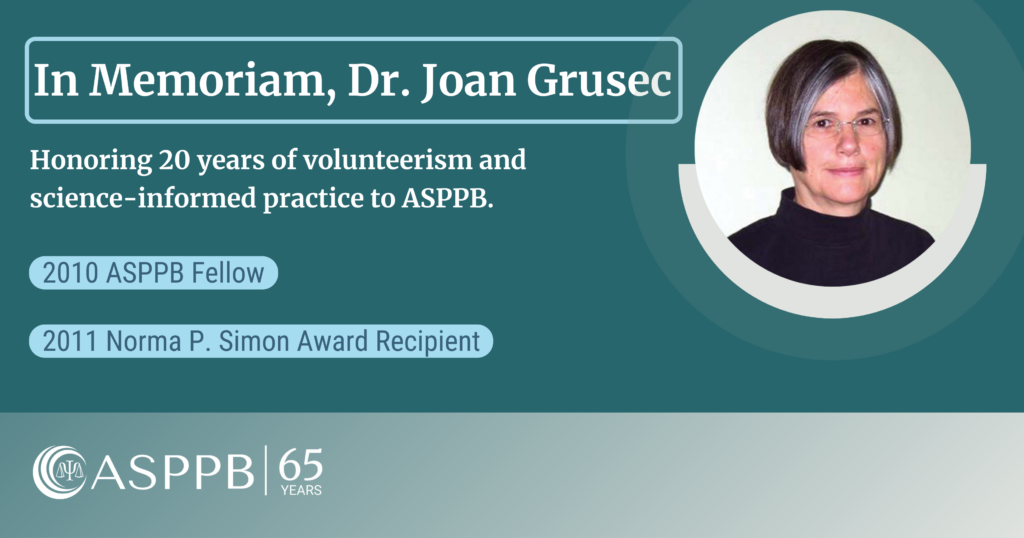
Joan’s scholarly output and impact were matched by exemplary professional service, both to the University of Toronto and to the broader field of developmental psychology. Joan was particularly committed to her years of work with both the Society for Research in Child Development (SRCD) and the Association of State and Provincial Psychology Boards (ASPPB). For SRCD, her leadership included coordinating the society’s meeting in Toronto in 1985 and chairing the History Committee. Joan’s goal of translating psychological science into science-informed practice was reflected in her more than 20 years of work with ASPPB. In this role, she strove to ensure that incoming cohorts of practicing psychologists possessed a solid basis of knowledge of pertinent theory and research. For these contributions, she was named a Fellow of ASPPB in 2010 and was presented with the Norma P. Simon Award in 2011.
Equally important to Joan were her roles as a teacher and mentor. She taught social development to thousands of students over more than four decades, many of whom have credited Joan for inspiring their enduring interest and pursuit of related careers. Joan also supervised the research of generations of undergraduate students, graduate students, and postdoctoral fellows, many of whom went on to establish their own independent academic and professional careers. Joan’s mentees valued her not only for her intellectual guidance, but also for her integrity, openness, passion, and genuine care for her students’ development as scholars and as people, which continued at every stage of their life and career. Across multiple cohorts, Joan’s trainees remember her fostering of independence and autonomy while providing structure and guidance, her enduring influence on them as a role model, and that Joan created a sense of community and family for her mentees. Joan frequently hosted dinners and events for her lab members, and occasionally housed some of them, at the home she shared with her husband and departmental colleague, Robert (Bob) Lockhart. Bob was warm, astute, and kind, and was cherished by Joan’s students, as were the couple’s beloved pets over the years. The enduring affection and sense of belonging of Joan’s trainees was evident in the well-attended, multi-generational “Grusec Lab Dinners” that were held at the biennial meetings of SRCD.
After years of deteriorating health, Joan chose the time of her passing through medical assistance in dying. She was at peace as she broke the news of her decision to others, helping them process the transition and part with her. Joan passed away on October 21, 2025, and was followed soon afterwards by her husband Bob. Joan and Bob are survived by their daughter Carolyn and her wife Maria, and their memory is honored and cherished by the countless other people they helped and touched over the years.
Joan E. Grusec’s contributions to the field of developmental psychology cannot be overstated. Joan leaves behind a lasting legacy of scholarship, mentorship, service, and humane insight into the lives of children, parents, and families.
Paul D. Hastings, Ph.D.
Class of 1995
Professor, Psychology
University of California, Davis
Duane Rudy, Ph.D.
Class of 1999
Associate Professor, Human Development and Family Science
University of Missouri
Maayan Davidov
Class of 2003
Professor, School of Social Work and Social Welfare
Hebrew University of Jerusalem