Prescriptive Authority for Psychologists: What Patients and Policymakers Need to Know

Advocacy , Psychology and Regulation Trends
Growing RxP Movement: Access, Convenience, and Continuity of Mental Health Care
The Prescriptive Authority for Psychologists (RxP) movement is an ongoing legislative effort in the United States that grants appropriately trained psychologists the right to prescribe psychotropic medications. Thus far, RxP has successfully passed into law in nine jurisdictions, with Hawaii being the latest to join Colorado, Idaho, Illinois, Iowa, Louisiana, New Mexico, Utah, and Vermont. Specially trained psychologists can also prescribe in the U.S. Department of Defense, the U.S. Public Health Service, and the Indian Health Service. These jurisdictions and U.S. service agencies use the Psychopharmacology Examination for Psychologists (PEP)® as part of the requirements that doctoral-level psychologists must meet to qualify for prescription privileges.
From Vision to Reality: The Evolution of Prescriptive Authority
For decades, psychologists have helped patients by treating mental and behavioral health conditions through assessment, diagnosis, and psychotherapy. As the nation’s mental health needs evolve and grow, states have risen to meet those demands. What was once a vision of having appropriately trained psychologists authorized to prescribe certain psychotropic medications is now a reality based on legislation that establishes the requirements for psychologists to gain authority to do so safely. These requirements include completion of a Master’s Degree in Clinical Psychopharmacology from approved programs, supervised clinical training in preparation to safely prescribe psychotropic medications, and passing a national examination, in this case, the PEP.

Joseph E. Comaty, MS, PhD, MSCP, MP, ABPP, ABRxP, is a nationally recognized Medical Psychologist (MP), educator, and co-author of the foundational psychopharmacology textbook Julien’s Primer of Drug Action. A longtime advocate for prescriptive authority (RxP) for appropriately trained psychologists, Dr. Comaty has played a significant role in advancing education and competency standards within the profession. Since 2017, he has chaired the Association of State and Provincial Psychology Boards’ (ASPPB)® PEP Examination Development Committee and, since 2018, has served as ASPPB’s liaison to the American Psychological Association’s (APA) Division 55 (Society for Prescribing Psychology).
For Dr. Comaty, prescriptive authority for psychologists is important because it enhances access to mental health care, promotes the evolution of the psychology profession, and contributes to interdisciplinary healthcare service delivery. “There is certainly a positive impact on access to mental healthcare as a result of RxP passing in the nine states that have legislation. Some of the research by Dr. Phillip Hughes has actually supported that.” Dr. Comaty also points out clear evidence that behavioral healthcare provided by prescribing medical psychologists has improved not only access but also quality of care, resulting in a significant reduction of adverse outcomes for individuals who have behavioral health disorders.
However, challenges remain in advancing the RxP movement. For each state to further legislation towards RxP, the process can be lengthy as it involves balancing constituents’ needs, listening to stakeholder opinions (both for and against RxP), considering the intricacies of political dynamics, and often having to reintroduce the bill numerous times in multiple legislative sessions before it gets enacted into law. However, data support the success of RxP.
“Since the Department of Defense project, we’ve had over 30 years of experience with psychologists being able to prescribe. So obviously, there is enough data to show that it’s safe and effective.” Dr. Comaty points out that if RxP has not progressed more quickly, it is not due to a lack of data supporting positive results. “All states are different. The pace may actually be picking up because there are certain periods of time during which multiple states pass laws very quickly, like Idaho and Iowa, which were one year apart. Colorado passed their legislation within one year. Utah passed it at the governor’s behest, without a prolonged campaign.” Each state has its own particularities, which illustrate how the political situation influences the outcome. “This year, we’ve had two states, Vermont and Hawaii, passing legislation, which is the first time that’s ever happened.”
It is no longer a matter of whether prescriptive authority is possible; it is also about the multiple considerations that policymakers need to evaluate, such as the benefits to constituents, sufficient training for psychologists, and financial considerations of implementing RxP.
There is also a cost to psychologists, but policymakers usually do not take it into account, as it is a choice each psychologist makes when embarking on the RxP pathway. “Another consideration that policymakers might have is how much RxP is going to save the state in terms of improved access to care, reduction in health care costs, and adverse outcomes for patients.”
What Prescriptive Authority for Psychologists Means for Patients

A patient who can see their psychologist next week for psychological treatment has to wait three months for the earliest psychiatric appointment. In the meantime, the person struggles to manage worsening anxiety while juggling work and family responsibilities.
For patients, having increased availability of specially trained psychologists who can provide both psychotherapy and medication management offers greater flexibility in receiving care, knowing that the psychologist has specialized education in clinical psychopharmacology, supervised clinical training, and has met licensing requirements to prescribe certain psychotropic medications.
What is important for patients to know about RxP is what it is not. Consumers of psychological services need to be aware that not all psychologists can prescribe and that psychologists are not physicians. However, psychologists who have passed the PEP have received training beyond the doctoral degree in psychology.
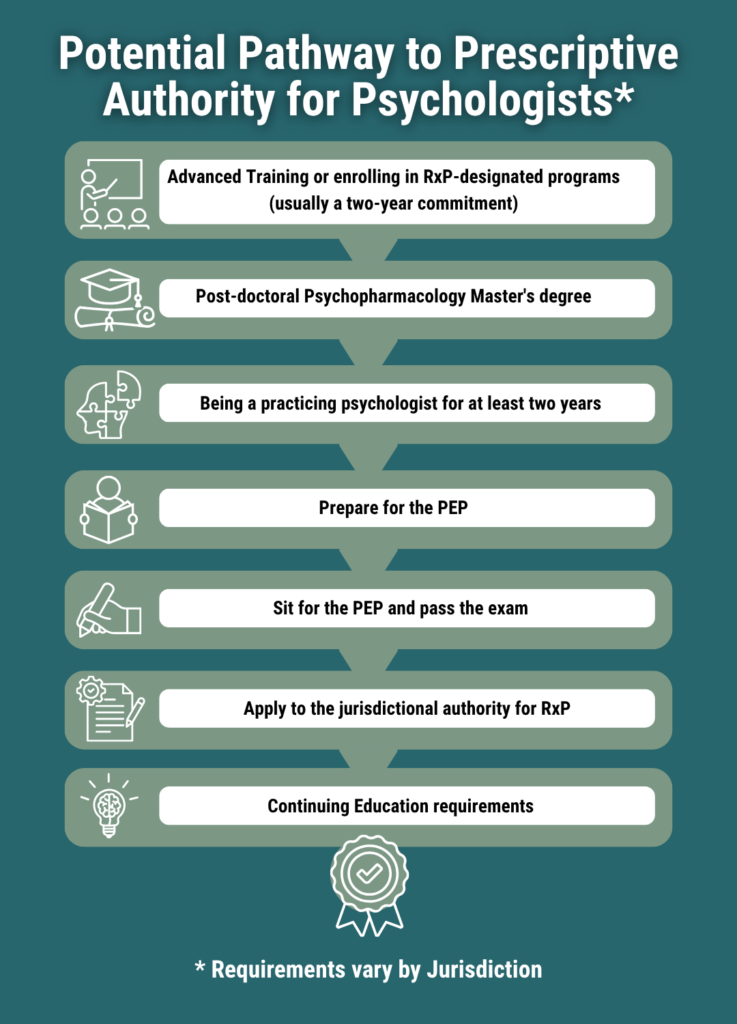
“Additional clinical experience requirements vary from program to program, but all require experiential supervision, and then, states have statutory and regulatory requirements in order to apply for the credential or license to prescribe,” said Dr. Comaty. “States may add additional experiential and supervisory training required to gain the privilege in that state.”
Training Standards towards RxP
Specialized education is a cornerstone of the RxP movement, as Dr. Comaty underscores: “Currently, there are six APA-designated training programs. The RxP designation through APA uses a standard curriculum, and all programs standardize their didactics.”
In addition, ASPPB’s Model Regulations for Licensure and Registration of Psychologists, a resource developed to assist jurisdictions in establishing licensure and regulatory standards and currently under revision, outlines the requirements for certification as a prescribing psychologist beginning on page 54.
On average, obtaining prescriptive authority for psychologists may involve a pathway with requirements that vary by jurisdiction.
The time to complete these requirements may vary from jurisdiction to jurisdiction. Psychologists must meet continuing education (CE) requirements after obtaining prescriptive rights. In addition to the required coursework, jurisdictions consider other elements, including supervised clinical experience, physical assessment training, and competency examinations.
Patients’ Complaints, Policymakers, and RxP
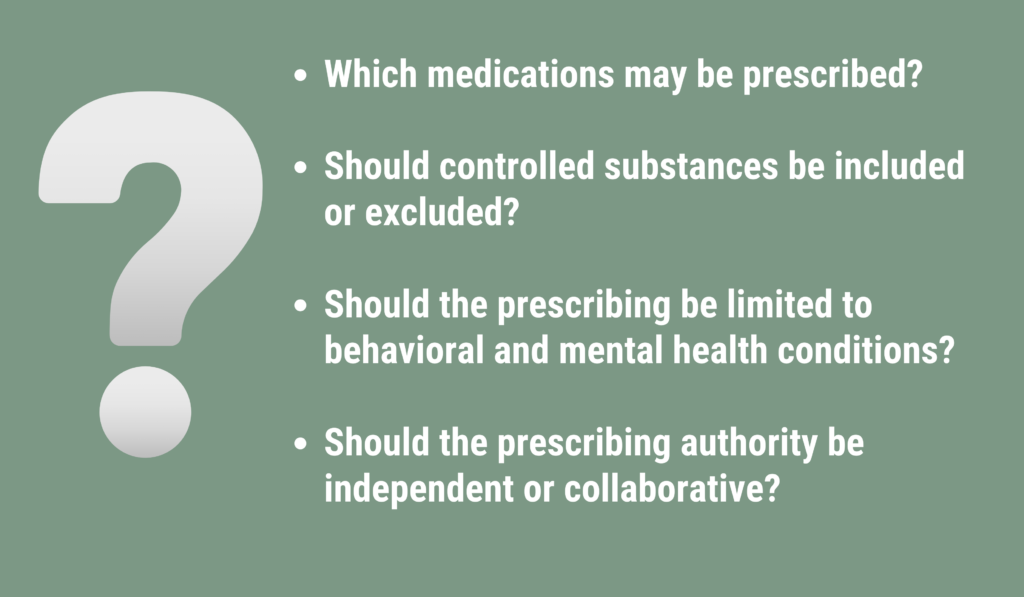
When it comes to policymakers, the question of prescriptive authority for psychologists is not whether expanding access to mental health care is desirable, but how to expand access while ensuring patient safety, regulatory accountability, and integration with the healthcare system. In short, the policy debate contemplates how jurisdictions establish a regulatory framework that expands access to care while maintaining the high standards of competence, safety, and public protection that patients expect.
Among the nine jurisdictions with RxP, Louisiana is the outlier in monitoring and adjudication. In all other jurisdictions, the psychology board monitors and adjudicates cases, sometimes with input from physicians who serve on the psychology board or are members of an advisory board. “In Louisiana, medical psychologists are licensed by the Medical Board. Complaints would go to the Board, and they would adjudicate any complaints,” said Dr. Comaty. In Louisiana, the Medical Board may consider input from the Medical Psychology Advisory Committee; however, the Medical Board remains the final authority.
Policymakers often rely on psychology boards, representatives of medical professions, educators, and subject-matter experts who can recommend standards that are rigorous, measurable, and enforceable.
These decisions shape both patient access and public confidence.
Building Effective Regulatory Oversight
Passing legislation is only the beginning. Policymakers must ensure there is a regulatory infrastructure to support implementation, including:
- Licensure requirements
- Complaint investigation processes
- Continuing competence standards
- Disciplinary procedures
- Prescription monitoring, where applicable.
Another consideration for jurisdictions is the integration of RxP into Existing Healthcare Systems, which include electronic prescribing systems, insurance credentialing and reimbursement, collaboration with primary care and psychiatry providers, access to electronic health records, and participation in prescription drug monitoring programs, where applicable.
The Future of RxP in the U.S. and Abroad
Dr. Comaty observed that the recent adoption of legislation in Vermont and Hawaii, and the decreasing time gap between states passing legislation, indicate increased momentum for RxP as current RxP states pass on valuable lessons learned to the states that are considering or have initiated legislation.
“I know that there are at least a half dozen or more states that have current active committees and have been constructing proposed legislation and preparing to submit. There are several states that currently have bills in the legislature that are still active,” said Dr. Comaty. “As we gain more states, the pace will pick up even further because information is being assimilated and utilized with the states that are considering passing legislation.” Dr. Comaty also commented that it is very encouraging to see interest in Canada, which is considering granting prescriptive privileges to psychologists.
As more states prepare to submit bills to the legislature, Dr. Comaty underscores the importance of APA’s Division 55 as a repository for literature on the effectiveness and safety of RxP as well as a resource for support, networking, and consultation. Another valuable resource is ASPPB’s Model Regulation for Licensure and Registration of Psychologists.